
From a no game golfer to plus handicap in 17 months
- Mar 22
- 7 min read
Updated: Mar 25

I came to golf properly in June 2024 when my friend Caroun, up from London for the weekend, suggested a round on a par 3 course after he'd had a batch of beginner lessons. I hadn't swung a club in 25 years but said yes anyway — and that was that. What followed was enthusiasm and, as it turned out, a fairly unhealthy obsession with a small white ball that has absolutely no intention of going where you tell it — one that my wife has been remarkably tolerant of.
Seventeen months later I was playing off a plus handicap and preparing for Open Championship Regional Qualifying.
This isn't a straight line story. It's full of detours, setbacks, thousands of range balls, more hooks, tops and slices than I care to remember, and at least two rounds where I nearly drowned. But if you're serious about rapid improvement, here's what actually worked — for me.
A word on my wife. When I described her earlier as "remarkably tolerant" of my obsession I should clarify — she lasted about two months before deciding that if you can't beat them, join them. Having never picked up a club in her life she took up the game from scratch, has since had more lessons with Jed than I have — seriously, more than me — peaked at handicap 14 and is currently playing off 20.
For someone who had never played before that's genuinely impressive. She has also, it must be said, patiently endured the minor meltdowns that accompany the odd hook into the trees or a duffed chip from six yards. Every golfer has them. Mine are apparently quite expressive.
Golf is now very much a shared obsession in our house, which makes the "remarkably tolerant" line considerably more complicated than it first appeared.
Finding the right pro matters more than you think
I went through five coaches before I found the right one. Everything changed when I started working with Jed Seeley at Old Joes Golf & Leisure near Sudbury, Suffolk. Jed worked with my body and my mechanics rather than trying to turn me into a textbook PGA swing...
I still go back to Jed regularly for tune-up lessons. The faults that creep in are almost always the same — rhythm and overswing....

The data changed everything

I invested in Arccos sensors early on — small GPS trackers that screw into each grip and automatically track every shot. Distance, direction, club selection, strokes gained across every part of the game.
For someone with an analytical background the data was immediately revelatory and occasionally brutal. It identified my short game as the fastest route to improvement early on. When I focused there, my handicap dropped quickly. Then it identified driving accuracy and distance as the ceiling on my scoring.
One caveat — the Arccos AI course strategy feature picks some decidedly optimistic lines. I've watched it suggest shots that will, with near certainty, find trouble. Use it for the data. Trust your own judgement for strategy. The AI hasn't yet learned that some of us are not Rory McIlroy.
The equipment journey
I started with a set of Lynx Black Cats from the early 2000s. A classic set with genuine vintage charm — and about as forgiving as a wet weekend in Windermere, which, incidentally, I have also played golf in.
I moved to Ping G425 irons — forgiving, consistent, excellent for yardage. They served me well for around a year. But as my handicap dropped I started to notice their limitations. Game improvement clubs are designed to be forgiving, which also means less responsive to trajectory control and shot shaping.

The final piece of the puzzle was switching to Mizuno JPX Tour irons, custom fitted with matched wedges. Higher ball flight, better green holding, much less rollout. The control is in a different category.
One thing worth understanding about the switch — my Ping 7 iron was lofted at 30 degrees, my Mizuno equivalent at 34 degrees. That loft difference means I now club down on virtually every approach shot. Total distance drops but control and stopping power more than compensate. Know your lofts, not just your distances.
How the handicap actually fell — and the honest version
It wasn't a smooth progression. Not even close.
By mid-autumn 2024 I was around 12 handicap. My first real milestone came at Rushmere Golf Club in late October 2024 — a 5 over par round that felt like a breakthrough at the time. Then the driver and woods went missing completely. A few howlers. Back to hovering between 10 and 12 over par on a good day.
Spring 2025 was when things properly shifted. Jed worked with my natural mechanics rather than against them and in April I broke below 5 over par for the first time — then found myself consistently scoring 2 and 3 over across multiple courses: Stoke by Nayland, The Essex, Lexden Wood, Newton Green, Rushmere, Haverhill and Bury St Edmunds. Something was genuinely changing.
Then came June 2nd, 2025. The Essex, County Course. I went under par for the first time — 1 under. Two days later, 4 under on the same course. Something had shifted permanently.
Throughout June and July I was consistently shooting low single figures with occasional level par rounds. A couple of 1 unders and a 3 under round at Benton Hall in July, followed by a 5 under at The Essex on July 30th — the best round of my life to that point. October brought a 4 under, a clutch of 3 unders, 2 unders and level par rounds at Gosfield. The season ended with under par rounds at Dunston Hall and Lexden Wood and a level par December round at Littlehampton on the south coast.
But here's the honest part. Golf went off the rails several times during all of this. Weeks where rhythm deserted me completely, where the overswing came back with a vengeance, where I couldn't have told you what I was doing wrong.
There were even days where I genuinely forgot how to play golf. Rounds where nothing — and I mean nothing — was working, where the scorecard crept past 100 and you're standing on the 18th wondering how you've gone from shooting 5 under to this in the space of a fortnight. It questions your sanity. Anyone who says that doesn't happen to them at this level is either lying or hasn't played enough golf.

And it wasn't just the scoring. I played through everything British weather could throw at me — dawn range sessions in temperatures that questioned my sanity, ice, snow, wind and rain that would make a sensible person stay home. I nearly came to a watery end at Aldeburgh on the Suffolk coast in conditions that had no business being described as playable.
I played the Lake District in weather that can only be described as an aggressive weather event. Thousands of range balls. Hands that forgot what feeling was on the drive home.
And more recently, I haven't played much at all. My mum passed away and a house move followed, and golf understandably took a back seat. My mid-irons are currently feeling flaky and I know exactly why. It'll come back.
The plus handicap didn't come from an unbroken run of improvement. It came from finding and grinding my way back every time it fell apart.
What drove the distance jump — and the short game revolution
For several months I hovered between 8 and 12, going round in circles. Two things broke the plateau simultaneously and both deserve equal credit.
The first was the driving. Distance and accuracy off the tee jumped significantly — from around 180 yards to consistently 250 plus with the driver, with 3 and 5 woods off the deck going well over 200. Suddenly par 5s were reachable in two. Birdie opportunities appeared that hadn't existed before. On a good day, 500 yards in two shots with a realistic sniff at eagle.
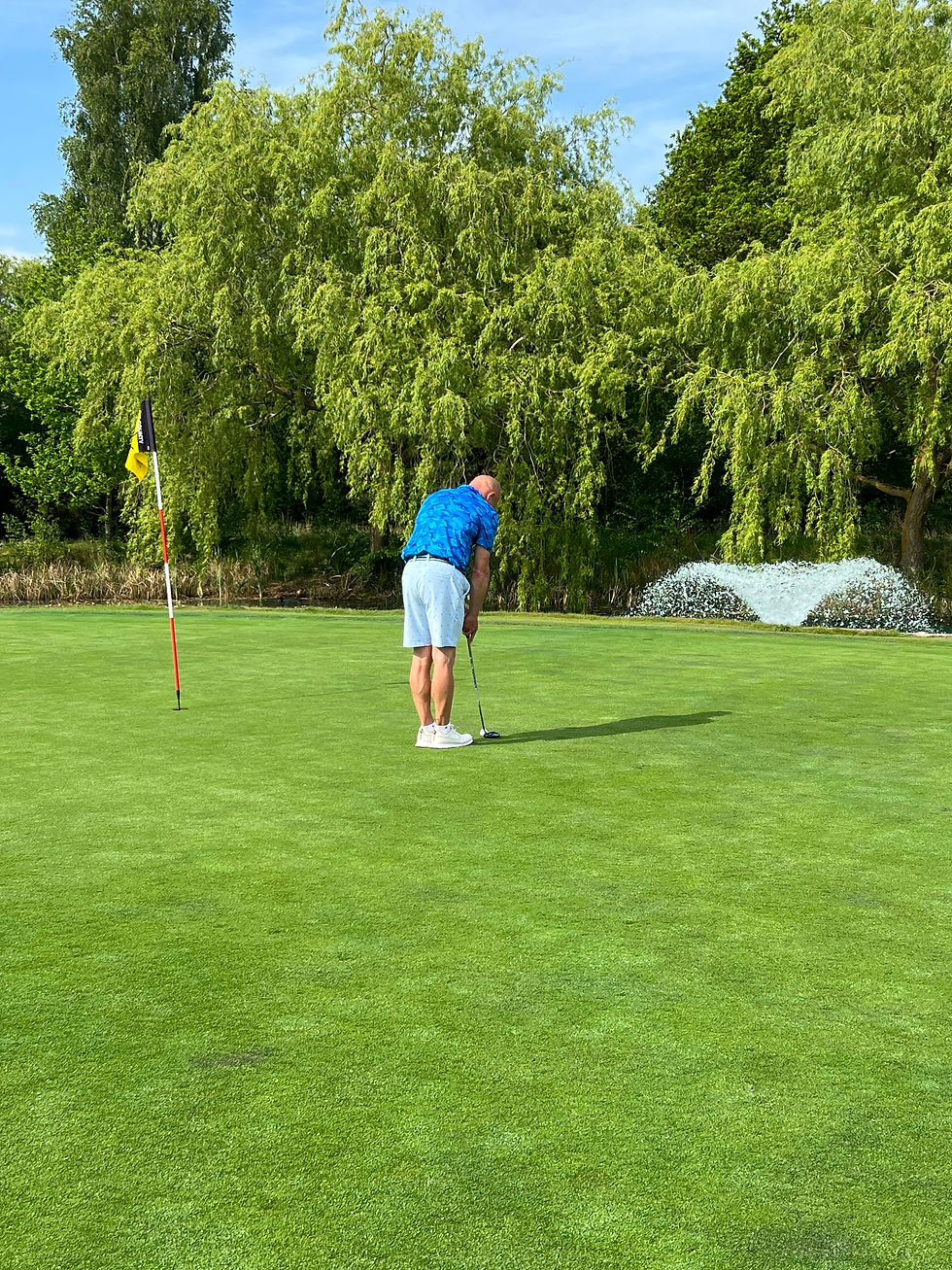
But equally important — perhaps more so in terms of raw shots saved — was what happened inside 100 yards. As the short game sharpened, the ability to drop the ball close to the pin became consistent rather than occasional fluke. The knock-on effect was dramatic. 3 putts became 2 putts. 2 putts occasionally became 1. When you're consistently getting up and down from inside 100 yards, the scorecard starts to look very different very quickly. It's unglamorous work compared to bombing drives, but it's where handicaps genuinely fall.
The driving opened up the course. The short game closed out the holes. Together they pulled the scoring average down hard and the handicap followed.
What I'd tell someone starting this journey
Age is not the enemy. I'm in my early 50s. On every tee there's invariably some youngster stepping up and launching it 300 yards into the distance while I'm quietly doing the maths on how to play the hole intelligently. Fine. Let them. Golf is one of the few sports where experience, course management and a sharp short game can genuinely outgun youth and raw distance. I'll take that trade every time.
Find your Jed. The right coach — one who works with you rather than a template — is worth more than any equipment upgrade. Don't settle.
Get the data. Arccos or similar. Stop guessing where you're losing shots and start knowing.
Match your clubs to your game, not your ego. Custom fitting isn't a luxury at a certain level — it's essential. And upgrade when your game demands it, not before.
Embrace the plateaus and the setbacks. They're not the ceiling. They're where the next breakthrough is being built.
Accept that you will occasionally shoot 100. It happens. Say nothing to anyone and move on.
Be honest about when life gets in the way. Golf is a game. Sometimes it has to wait. It'll come back.
The journey from a no game golfer to plus handicap in 17 months wasn't about talent. It was about obsession, the right support, honest data, equipment that matched where my game actually was — thousands of range balls, several near-meteorological incidents, and finding my way back every time it fell apart.
Regional Qualifying for The Open is next. That story is still being written — along with some other mildly crazy golf related plans.
David Tuscarny is the founder of ChippedIn — where golf content meets real experience, for anyone who loves the game.



Comments